Starting Your Path to Certification

Becoming a GIS Professional (GISP®) through the GIS Certification Institute (GISCI) is a key milestone in your geospatial career. The GISP® credential recognizes your education, professional experience, contributions to the profession, and core technical knowledge — along with your commitment to ethical practice. 
 
GISCI intends to equip prospective GISPs with a practical pathway from college graduation to certification. Our resources will help you: 

  • Assess your current knowledge with the optional PreGISP® Exam 

  • Plan your professional growth through education, experience, and contributions 

  • Prepare for the GISCI Geospatial Core Technical Knowledge Exam 

  • Complete your GISP® Portfolio and earn certification 

With careful planning, consistent documentation, and engagement in the GIS community, you’ll be ready to join a respected network of geospatial professionals shaping the future of GIS. 

Differences Between GISP AND GISP-E
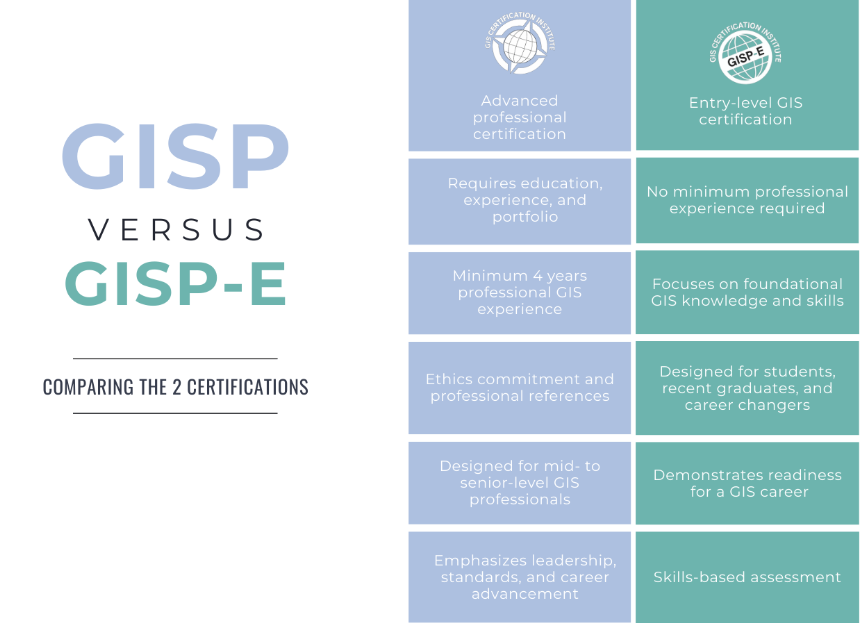
 

Pathways to Becoming a GISP-E and a GISP® 

The diagram below shows the simplified pathways for becoming an Emerging GIS Professional (GISP-E) or a GIS Professional (GISP®).

Explore your pathway's timeline here.

Why the GISP-E Matters 

  • Demonstrates Readiness: Shows employers that you possess a verified understanding of geospatial concepts, data management, and applied GIS methods. 

  • Strengthens Your Résumé: Highlights your commitment to professionalism and continuous learning — traits hiring managers actively seek. 

  • Opens Career Doors: Many agencies and firms use credentials like the GISP-E as a differentiator for internships, entry-level analyst roles, and early promotion opportunities. 

  • Builds Confidence: Confirms that you’re on the right track in your education and training before accumulating the experience required for the full GISP® credential. 

  • Signals Ethical Commitment: The GISCI Code of Ethics and Rules of Conduct apply to all credential holders, establishing your reputation as a responsible professional from the start. 

Pro Tip: Think of the GISP-E as your professional launchpad — proof to yourself and others that you’re serious about a career in GIS and committed to lifelong learning. 

How to Earn It 

  1. Apply through GISCI.org – sign up online to take the exam following the PreGISP® Exam application instructions. 

  1. Meet Education Requirements – typically a degree or equivalent coursework in geography, GIS, or a related field.  You must graduate or have graduated within the last 6 months. 

  1. Complete the PreGISP® Exam – the PreGISP® differs from the GISCI Core Technical Knowledge Exam® used for the full GISP® certification. Prepare and be ready for success! 

  1. Stay Engaged – participate in professional activities, training, and community service to begin accumulating portfolio points for your future GISP® application. 

For more tips on preparing for the exam, click here. 

Summary Pathway Checklist 

Step 1: Education – Earn degree, save transcripts, document coursework 
Step 2: Experience – Work in GIS role, track hours and responsibilities 
Step 3: Contribution – Attend events, volunteer, publish, or present 
Step 4: Exam – Prepare with Study Guide and practice exams 
Step 5: Portfolio – Submit complete documentation to GISCI 

 
Step 6: Certification – Earn the GISP® credential and maintain active status 

Pro Tips for Success 

  • Use a personal email address for your GISCI account 

  • Track education, experience, and contributions continuously 

  • Build your network early 

  • Keep learning 

  • Certification reflects professional integrity